Showing posts with label Error. Show all posts

Thursday, December 31, 2015

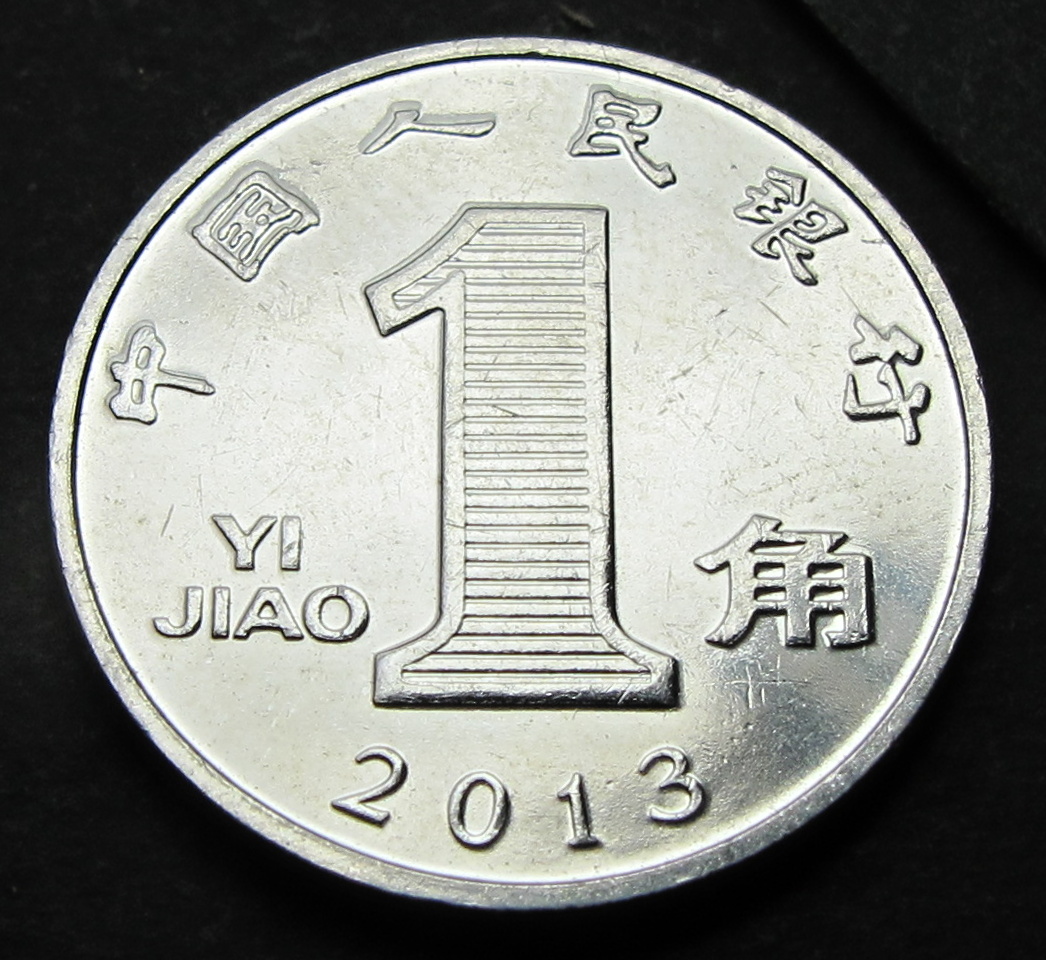
2013 China 1 Jiao

No. This one does not have machine doubling...


So many are made that machining doubling could be common but high efficiency in making coins makes mistakes less common. It was shadows from a strong light in one direction. At the end it still has no extra value.

Here's the stats for both coins...
Type/Country: 1 Jiao / People's Republic of China
Year: 2013
Mintage: Not yet known.
Metal: Stainless Steel
Value: $0.10 in XF

Do you have a Chinese coin and want to know its value? Leave a comment/question and I will do my best to find out the price and history for you.

Tuesday, August 05, 2014

2013 British 10 Pence

Now with die breaks! I found three of these and this one is the only one with many die breaks. One so big it surrounds the entire profile of the queen.

It looks like doubling on the front around the queen's head but it is a massive die break. The edges of the design is where coin dies tend to break. When it does it causes the coin to shift when the coin is pressed. On the back you see the rim has the odd doubling and some die cracks appear on the bottom lion.

None of this adds value but it does look cool compared to normal ten pence coins.

Here's the stats...
Type/Country: 10 Pence / Great Britain
Year: 2013
Mintage: Not yet known.
Metal: Copper-Nickel
Value: $0.10 in F

Do you have a coin from the United Kingdom and want to know its value? Leave a comment/question and I will do my best to find out the price and history for you.

Friday, May 09, 2014

2001-P Canada Volunteer 10 Cents

In honor of the millions of Canadians, in particular mothers, that volunteer to make Canada a better place the government made this dime. Of course it is also a nod to the March of Dimes foundation as the women on the reverse are in a standard marching lineup.


This coin looks very nice but suffers from a lot of no value mint errors. It has been seen with die clashes and die gouges. Toward the edges you can see where the design and the rim meets that the metal is peeling. I am not sure what causes this but it happens at minting and is so common that it does not add value, just the opposite it takes away value.

Here's the stats...
Type/Country: 10 Cents / Canada
Year: 2001 P
Mintage: 224,714,000
Metal: 92% Steel, 5.5% Copper, 2.5% Nickel
Value: $0.10 in G-4

Do you have any Canadian coin and want to know its value? Leave a comment/question and I will do my best to find out the price and history for you.

Wednesday, December 04, 2013

1982 British 20 Pence with Doubling

The first and most common 20 Pence from Great Britain is this one. 1982 was the first year of issue because of a growing need for a coin smaller than a 50 Pence but larger than a 10 Pence. The more common 25 or quarter coin was suggested but the British thought 20 was an easier round number to use.


The coin has seven sides and is about the size of a U.S. nickel. It also has a higher copper composition than most Copper-Nickel coins. This was done for both the visually impaired and vending machine industry. The reverse has the crown, date, denomination, and a double rose.


The entire right side of the reverse is doubled. While I cannot be a hundred percent certain I think this is machine doubling. Machine doubling is the less valuable version of double that occurs when the die slips or bounces when striking the coin. Since almost one billion were made it is not a surprise that doubling does exist although I could not find more online.

Here's the stats...
Type/Country: 20 Pence / Great Britain
Year: 1982
Mintage: 740,815,000
Metal: 84% Copper, 16% Nickel
Value: $0.40 in VF

Do you have a coin from Great Britain and want to know its value? Leave a comment/question and I will do my best to find out the price and history for you.

Friday, August 30, 2013

2007 Colombia 50 Pesos, Off-Center Error

Have a Colombian coin and want to know its value? Leave a comment

So I finally get a foreign coin in my change after months of nothing and it is also an error. Granted from my research a large portion of the 2007 Colombian 50 Pesos coins are off-centered. Most of them even look the same so it probably was an error that continued for a while.


Note the edge. According to all the descriptions the edge should be reeded but this one is smooth. Granted it also is a railroad rim which means it has a ledge to the edge, hehe that rhymes. Since this was off centered when pressed the edge can have a number of unusual appearances. 

On eBay a quick search shows most of these are going for around $6.00 but there are so many I doubt this is a realistic vale. Common errors can go for $2.00 or less and foreign errors generally are not  prized among collectors. None of the design was cut off so it is not the ideal off center error but the rim is affected so that adds a little value. 

Here's the stats...
Type/Country: 50 Pesos / Colombia
Edge: Not Reeded, Railroad Rim error
Year: 2007
Mintage: 29,300,000
Metal: Copper-Zinc-Nickel
Value: $3.00 in Extra-Fine, $0.03 in exchange value

Do you have a coin from Colombia and want to know its value? Leave a comment / question and I will do my best to find out the price and history for you.

Wednesday, May 08, 2013

Another Copper Dime

Have an error and want to know its value? Leave a comment

It looks much more copper in hand and weighs 2.27 grams. So is it an error?


I think it may be something else maybe Improperly Annealed or unintentionally chemically altered. Either way I found other copper dimes before and none have been underweight as a true missing clad error would be.

A close inspection of the edge (not pictured) reveals there seems to be a sandwich. Meaning the clad layers are visible but it looks like light copper, dark copper, light copper. It could be a heating error before minting or some attempt at cleaning after leaving the mint.

I will keep it but I do not expect it will every be proven to be anything special.

Here's the stats...
Type/Country: 10 Cents / United States
Year: 1994 D
Mintage: 1,303,268,110
Metal: 91.67% Copper, 8.33% Nickel
Value: $0.10  in F-12

Do you have a U.S. dime and want to know its value? Leave a comment / question and I will do my best to find out the price and history for you.

Friday, February 15, 2013

Bad Doubling!

Die Deterioration Doubling
Let me preview an example of a not true doubled die error.


Die Deterioration Doubling (DDD)
That is what you see above. The die used to the make the coin is going bad and the edges of the design start to flow outward and spread. That causes a doubling and other problems. As the die starts to break down they are polished again and used for a while leaving classic straight polishing lines.

None of this adds value and in high grade coins will actually lower value.

Tilted and repositioned you can see streaks or lines running across the entire coin, these are polish marks.

The back is also full of Deterioration Doubling and the zinc core is partially exposed.

Lincoln's hair has a slight doubling.

The P in PLURIBUS shows the most extreme doubling but every element on the reverse has the bad doubling.

The die deteriorating raises the metal on the design and when pressing the coin it forces more copper out of the way exposing the zinc underneath. the copper plating is very thin and if the design cut is too deep it will show the zinc core.

Again tilting the cent shows most of the doubling and artifacts like streaks and exposed  zinc.

It is like a hill of metal or a drift or pile like after a snow storm.

Even the building has the problem as you can see the zinc coming out on the left hand side.

Among all coins this is common but it is most often seen among the cents in the U.S and Canada. Nickels also sees this kind doubling often since it takes a greater force to make a nickel and the metal flow is great causing faster deterioration.

Let me emphasize these are errors but not valuable kinds. This is just worn and old dies and since it happens often that does not make it valuable. Sometimes called a "Poorman's Doubling" it fools many to think they have something rare.

Should you still collect DDD error coins? I would say no but some extreme examples looks cool and as long as there is eBay there is always a market.

Friday, November 30, 2012

MAD Dime

Have an error and want to know its value? Leave a comment

MisAligned Dies or MAD for short are error coins that have one side slightly off-center because the die hit it wrong. The coin enters the collar and a die from above (hammer die) hits the coin and simultaneously the pressure causes the bottom die (anvil die) to leave an impression on the coin. If the hammer die is slightly off the back and edge would be normal only the front would be off. Many MAD varieties exist but this is the most common.


The most obvious sign is on the rim where it looks like the dime has two edges. This is often mislabeled as "railroad rim" but that is another type of error where the edge is struck partially out collar. There is no good nickname for this error but it is common.


It is most common amongst dimes, the small size is partially to blame. Finding them in all coins is possible but the quarters and dimes are most obvious since the edge is reeded. Unless the misalignment causes part of the design to get cut off it has no extra value. Ignoring the eBay sales of these common coins they are not popular among collectors if minor or heavily circulated. Often the centered side is very weak but if both sides are misaligned they can have weak spots. Only extreme misaligned dies have real value and then they get odd looking.

Here's the stats...
Type/Country: 10 Cents / United States
Year: 1998 P
Mintage: 1,163,000,000
Metal: 91.67% Copper, 8.33% Nickel
Value: $0.10  in F-12

Do you have a U.S. dime and want to know its value? Leave a comment / question and I will do my best to find out the price and history for you.

Friday, October 05, 2012

1964-D Nickel, Double Clip Planchet

Have an error and want to know its value? Leave a comment

A double clipped planchet is a coin the has two missing sections. The clips are made before the coin is pressed. When the sheets of metal are cut during the coining process they try to make each circle as close as possible for efficiency. Sometimes if the rolled sheets skip, bend, or gets stuck the cutting overlaps. So a cut section gets cut again and you have an error known as a clipped planchet.


These are very small clips and usually only those that are missing 10% or more carry high values. Not that these are common but among clipped planchet errors these are not as collectable.


Here are two great links discussing the error in detail. First from a Coin Talk forum page and another from a Fluer-DeCoin article. Found this error in my change and the only surprise is that it lasted that long without anyone else taking it. I am guessing it is such a minor error that it stayed unnoticed.

Value is going to be pretty low since it well circulated and less than a 10% clip. Still a double clip is neat and not my first but probably the most obvious. Straight clips and ragged clips are also found in change but when less than 10%  they are difficult to verify.

Here's the stats for this error coin...
Type/Country: 5 Cents / United States
Year: 1964-D
Metal: 75% copper 25% nickel
Mintage: 1,787,297,160
Value: $5.00 in VF-20

Do you have a nickel and want to know its value? Leave a comment/question and I will do my best to find out the price and history for you.

Friday, September 21, 2012

2012 Cent, Die Breaks

Have an error coin and want to know its value? Leave a comment

Die breaks or die cracks either way it happens when the die used to press the coin starts to crack and eventually completely breaks. Alert mint employees should notice the tiny cracks before that happens stop production, recycle the error coins, and replace the die. A great article from Coin World shows how the U.S. mint is trying to eliminate Die Breaks using a visual check list. 


The front is normal without any hint of error.


At least three major cracks with a large cud on the the top of the shield and a long crack from the rim over the O going towards the center of the coin. There are a few minor cracks on the shield and a few of the letters but they are very small.


The die crack must have been deep because the longest break is very pronounced. It sticks out from the coin above any other design element. 

I also love the fact they call the error checking poster "2011 PENNY TYPICAL DEFECTS" showing that penny is an official term for cent coins. From that chart I can see two if not three of the areas on my coin had breaks exactly where they predicted.

Here's the stats...
Type/Country: 1 Cent / United States
Year: 2012
Mintage: about 2.2 billion to date
Metal: 97.5% Zinc, 2.5% Copper
Value: $0.01 in AU but...

While I would not place any extra value on die breaks I have seen them being sold for about $2.50 on average in high grade. I did not find any 2012 cents online with such obvious cracks so this one may be worth more if indeed the mint is making greater efforts to eliminate errors.

Do you have an error cent and want to know its value? Leave a comment/question and I will do my best to find out the price and history for you. 

Thursday, August 02, 2012

1972 Cent, Machine Doubling

Have an error coin and want to know its value? Leave a comment

Strike doubling, mechanical doubling, or machine doubling are just a few names for a coin that gets slightly shifted when being struck leaving what looks like an image doubling. Either the coin shifts or the die bounces and strikes the coin two or more times.

The flatter secondary image is often at a lower level. Were it true doubling the secondary image would be at the same height and have the same curvature. It takes a while to tell the difference but once you see a real Doubled Die you know.


Know this, I generally take a quick glance at my change for doubling. The 1972 cent is one of the exceptions where I do more than glance at I check every angle in good light. This year having a famous variety makes me always look carefully. I have found a more common 1972 Doubled Die before but this one I just found is not true doubling.

Machine doubling is a type of error that can be found on every coin. They rarely have extra value and although I have seen some being sold this is not done by professional collectors.

Here's the stats...
Type/Country: 1 Cent / United States
Year: 1972
Mintage: 2,933,255,000
Metal: 95% Copper, 5% Zinc
Value: $0.02 in G-4 (Although this one maybe less.)

Do you have a Doubled Die cent and want to know its value? Leave a comment/question and I will do my best to find out the price and history for you.

Friday, June 15, 2012

Clad Planchet Dime

Have a blank coin and want to know how much it's worth? Leave a comment

First blank coin I got in my change ever. Just a few days ago I was at the store and decided to use cash, which I have not been doing lately, when I instantly saw this kind of yucky dime. At first I thought it was weakly struck or damaged. Still hopeful I brought it home, shook off all the loose dirt, and weighed it. Turns out it was real.


One side is a bit "rusty" with what appears to be water spots. Both sides are very scracthed and there are some rim dents. The edge is not reeded but you can clearly see the clad layers.

It weighs between 2.26-2.27 grams because my scale kept going up and down by 0.01 gram. That said a normal dime weighs 2.27 grams so it could not be shaved. The size is slightly smaller but within normal limits.

Never seeing a blank in hand but having a few other planchets I am fairly sure this is a Type 2 blank planchet. Type 2 means the rim was upset or formed enough to be a bit concave. The Type 1 Blank was just punched out and would be completely flat. So a coin goes from flat sheets to punched out blanks to planchets with slight rims and then they get stamped into coins.

Here's the stats...
Error: Blank Planchet Type II
Type/Country: 10 Cents / United States
Year: Unknown (1965-2012)
Mintage: N/A
Metal: 91.67% Copper 8.33% Nickel
Value: $1.75 in VF-20

Do you have an error coin and want to know how much it's worth? Leave a comment/question and I will do my best to find out the price and history for you.

Tuesday, March 29, 2011

Off-Center Georgia Quarter? (Correction)

Do you have an error coin and want to know its value?

Off-center coins are defined by being struck out the collar, which makes the reeded edge, and only partially struck between the dies.

To qualify as a collectible error it should have part of the design cut off which in most cases needs to be 10% off-center. Percentage is measured by how much of the coin is blank versus how much was stamped, also including the rim as part of the design.

Note the rim is gone at some point
Note the rim is full but thin at some point

Edges of the coin where the rim is normal, at the points where the rim is wider and narrower than normal there is no trace of the reeded edge.

This coin is 5% off-center at K-10. The K-10 means that the widest part of the blank space is at 10 o'clock on the obverse of the coin. Value in this condition is maybe $0.50 but nearly impossible to sell.

Here's the stats for a normal South Carolina P quarter...
Type/Country: 25 Cents- Georgia/ United States
Year: 1999P
Metal: 91.67% Copper 8.33% Nickel
Mintage: 451,188,000
Value: XF-40 $0.50(only because of the error)

UPDATE: 
Anonymous said:
Georgia quarter is NOT an off center coin. Technically is it called a "misaligned die". It is not off center because the obverse is centered and the reverse is not. This happens when one of the dies is not in line at the time of striking. To be an off center coin the obverse and reverse must BOTH be off center to the same degree. thank you
Man said:
I was debating this since an Offset Die Misalignment Strike is consistent with this but the off-center was very close on both sides. Plus the coin is not struck fully in collar.

Upon your opinion and further review yes the anvil die is still partially in collar and I will change the post but I'm still not 100% convinced.

Thanks.
Offset Die Misalignment Strike is defined by being struck in collar when one die is off-center (having the partial design & rim missing)  and the other side may also be off-center but is still in collar and has a rim.

What had me debating was the fact that most Misaligned Die errors should have been struck in collar but I forgot partial reeded edge does count.

Thanks I'm still learning and always appreciate more opinions.

Do you have an error quarter and want to know its value? Leave a comment/question and I will do my best to find out the price and history for you.

Thursday, July 09, 2009

Broken 1957D Cent

Do you have a wheat cent and want to know its value? Leave a comment

Back in early 2008 I found a 1957-D cent that was red and brilliant it was amazing that it came from my change. Post here, pictures here and here.

Now a little over a year and I found one in a lesser grade. The problem with this is it may be Doubled Die either a 1957D-1DO-001 or 1957D-1DO-004 or one of the 12 other minor doubling. The doubling on most 1957-D cents are so minor that they can only be seen in high grades.

Late Die Stage or LDS is the stage in the die (used to press the coin) right before it is taken out of service or has been polished again for further use. LDS markers include multiple scratch lines, die breaks, and weak details.

Enough of the technical stuff see the coin and point out the issues.

You can clearly see the B in LIBERTY is half filled. The 95 in 1957 are also partially filled and on the reverse the second U in UNUM is filled.
Were this picture and better you could the entire 1957 has extra metal and so does the D below the date.

All in all if I could dub this a doubled die variety it would be worth at most $1.00. Not much of incentive to research further.

Here's the stats...
Type/Country: 1 Cent / United States
Year: 1957D
Mintage: 1,051,342,000
Metal: 95% Copper, 5% Tin and Zinc
Value: $0.05 in F-12 plus the die breaks that may mean something more

Do you have an older cent and want to know its value? Leave a comment/question and I will do my best to find out the price and history for you.

Tuesday, June 23, 2009

Edgy Situation

Do you have a dollar coin and want to know how much it's worth? Leave a comment/question and I will do my best to find out the price and history for you.

On the quest to find one of every coin ever made from my change including varieties, sub-varieties, and errors I have come across more circulating dollars.

These two circulating presidential dollars are both from the Philadelphia mint, which is more common on the east coast. James Madison, 4th president issued in 2007 and John Tyler, 10th president issued in 2009.

So of the ten currently out I have the 1st, 3rd, 4th, 5th, 6th, and 10th. 60% not bad considering the slow start to get circulating.

Some slight die cracks or die chips on the lettering but nothing exciting but it is the first time I notice them among golden dollar coins.


The topmost picture was taken with a camera the rest were done on a scanner still the color of these coins in real life is somewhere in between. Yes 5 years and I still can't get the settings for a true life image.
Notice anything else different?
Well since you can't really give hints on the internet I'll just say it. The motto IN GOD WE TRUST was placed back on the the front of the coin.

Originally the law called for both mottoes, the date, the mint mark, and small separating elements be incused on the edge. Then a small group of, how can I put this diplomatically, conservatives lobbied to change the law. The group felt there was a conspiracy to abolish the big G-O-D from society starting with coins. This of course is not true.

For collectors have edge lettering is unique and then edge-incused lettering is even more special and a great honor. That fell on deaf ears as certain common errors occurred and the edge letters went missing for about 0.01% of the dollars. This led to a bigger phonier brouhaha and pressure to move the motto.

The best image I could take of the edge lettering.

The top 2009-P John Tyler dollar has the lettering normal or head side up. Visible is E. PLURIBIS .
The bottom 2007-P James Madison dollar has the lettering upside-down or tails side up. Visible and upside-down is GOD WE or ǝʍ poƃ( capitalized of course) .

Here's the stats but be aware all mintage's are estimated and it may takes years to get an accurate count...
Type/Country: 1 Dollar-John Tyler / United States
Year: 2009 P (Edge normal)
Mintage: 43,540,000
Metal: 88.5% Copper, 6% Zinc, 3.5% Manganese, and 2% Nickel
Value: $1.00 in G-4
Type/Country: 1 Dollar-James Madison / United States
Year: 2007 P (Edge upside-down)
Mintage: 87,780,000
Metal: 88.5% Copper, 6% Zinc, 3.5% Manganese, and 2% Nickel
Value: $1.00 in G-4

Presidential Dollar Coin Release Schedule Courtesy of USMint.gov
Year
President Years Served Release Date
2007 1 George Washington 1789-1797 February 15
2 John Adams 1797-1801 May 17
3 Thomas Jefferson 1801-1809 August 16
4 James Madison 1809-1817 November 15

2008 5 James Monroe 1817-1825 February 14
6 John Quincy Adams 1825-1829 May 15
7 Andrew Jackson 1829-1837 August 14
8 Martin Van Buren 1837-1841 November 13

2009 9 William Henry Harrison 1841 February 19
10 John Tyler 1841-1845 May 21
11 James K. Polk 1845-1849 August 20
12 Zachary Taylor 1849-1850 November 19

Do you have a dollar coin and want to know how much it's worth? Leave a comment/question and I will do my best to find out the price and history for you.